Maker Journal
I Built a "Can We Boat?" App So My Kids Would Stop Asking Me Every Five Minutes
My kids ask "can we go on the boat today?" more mornings than not, and I say yes more than I should, only to have everyone disappointed once we're already packed up and the water isn't cooperating. So I built Can We Boat?, a free go/no-go boating conditions app they can check before we ever load the car.
Most mornings during the summer, the question comes before I’ve even finished my tea. “Can we go on the boat today?” It’s not a bad question. It’s just one my kids ask constantly, and if I’m honest, I say yes more often than I probably should. Nobody wants to be the parent who says no, so I’d give the optimistic answer, and we’d get moving: load the cooler, dig out life jackets, find everyone’s water shoes, argue about who sits where in the car.
Then we’d actually get to the water, and more times than I’d like to admit, it was too choppy or too windy to be any fun. Now everyone’s disappointed, except it’s a worse kind of disappointed, because we already did all the work of getting ready. Finding out a trip is a bad idea five minutes before you load the car is annoying. Finding out after everything’s packed and everyone’s buckled in is a completely different level of letdown.
So I built a tool that looks at the numbers for me.
The Problem With “Can We Go On The Boat?”
Marine weather isn’t hard to find. It’s hard to interpret quickly, and it’s definitely not written for an eight-year-old. NOAA’s marine forecast reads like a shipping bulletin. Wind is one site. Waves are another. Tides are a third. None of them tell you the thing you actually want to know, which is: is today a good day, a rough day, or a stay-home day?
I was doing this translation manually every morning; check the wind, check the wave height, check the tide, mentally combine all three into a gut call, then explain that call to two kids who don’t care about wind speed in knots. They just want to know if we’re going.
That gap, between “here are six numbers from three different sources” and “yes, kinda, or not today”, is exactly the kind of thing I like turning into a small app.
What I Built
Can We Boat? is a free, browser-based boating conditions tool. No install, no account, no ads. You either allow location access or search for a marina, ramp, or town, and it gives you a clear verdict for the next several hours.
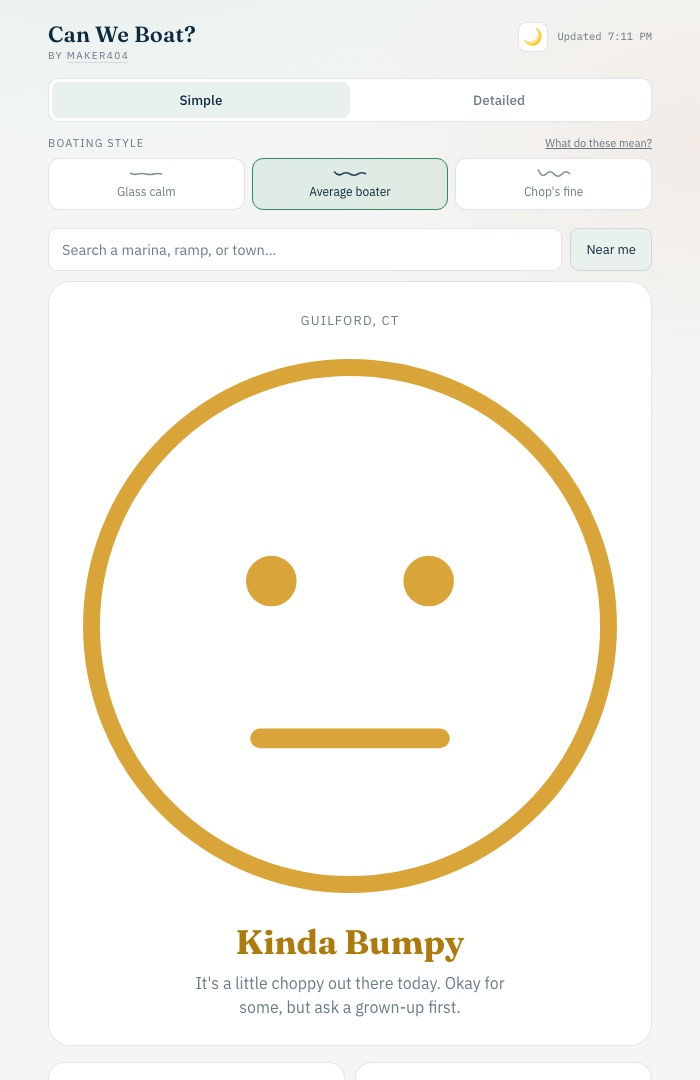
There are two views. The Simple view is the one my kids actually use: a big face (happy, so-so, or worried), a one-sentence explanation like “It’s a little choppy out there today. Okay for some, but ask a grown-up first,” and four or five plain stats: wind, waves, next high and low tide, water temp, and sun. They can check it themselves before they come find me.
The Detailed view is the one I use: the same go/caution/no-go verdict, but backed by a full breakdown, an actual tide chart for the day, and the National Weather Service’s marine forecast and any active Small Craft Advisories for the zone we’re in. If there’s a real advisory out, it shows up as a banner in both views, because that’s not information I want buried in the detailed screen only.
The Boating Style Selector
The hardest part to get right wasn’t the weather data. It was figuring out what “too rough” even means, because it depends entirely on who’s on the boat and what they’re doing.
Instead of asking people to define their own thresholds, I built three presets:
- Glass calm is for young kids, first-timers, or anyone who wants a mirror-flat morning
- Average boater is the default, reasonable chop is fine, but it flags anything building toward genuinely uncomfortable
- Chop’s fine is for people who don’t mind a bumpy ride
Whichever one is selected changes the wind and wave thresholds that drive the verdict. There’s also a “What do these mean?” link right on the page that shows the exact numbers behind each style, because I don’t like tools that hide their own logic.
One thing that surprised me while building this: the rating is driven mostly by peak wind gusts, not the average wind speed. A day can show up as only 5 or 6 mph average wind and still get flagged as Caution, because the forecast has a gust spiking to 20+ mph in the next few hours. That felt wrong the first time I saw it until I thought about it for two seconds: a sustained 6 mph breeze is nothing, but a sudden 20 mph gust is exactly the kind of thing that catches a small boat off guard. Average wind is comfortable. Gusts are what actually get you.
How I Built It
Like most of what I put on this site, it’s a single HTML file with no backend, deployed as a static page. No server costs, nothing to maintain beyond the code itself.
The data behind it is all free, with no API keys:
- Wind and wave forecasts come from Open-Meteo, including their dedicated marine API for wave height, period, and sea surface temperature
- Tide predictions come from NOAA CO-OPS, using the nearest tide station to whatever location is selected. For smaller stations that only publish high/low times and not a full hourly curve, the app approximates a smooth tide curve from those points so there’s still something useful to look at
- Marine zone forecasts and Small Craft Advisories come from the National Weather Service API, the same source that feeds the official marine forecast pages
Location comes from the browser’s Geolocation API, with a plain search box as a fallback for planning ahead or checking a spot you’re not standing at yet. Light and dark mode are both supported, since half the time I’m checking this before sunrise.
Where This Fits for Us
The actual routine now is boring in the best way. Someone asks if we can go on the boat. Instead of answering from memory or guessing, I open Can We Boat? on my phone, and increasingly, my older kid just opens it herself. Green face, we’re going. Yellow face, we talk about it and maybe wait a few hours. Red face, we do something else, and there’s no argument about it because the app said it, not me.
It’s a small thing. It’s not going to change anyone’s life. But it’s already saved us from at least one trip where we would have packed the whole car for nothing, and it’s turned a repeated argument into a thirty-second check before anyone touches a cooler. For a free tool built in a few evenings, that’s a pretty good return.
Try it at maker404.com/apps/can-we-boat. No account, no install, no cost, and hopefully a few less “can we go on the boat” arguments in your house too.